Saturday, December 15, 2012

Why Your Neighbor Should Buy an Electric Vehicle (EV)

 I will begin by conceding to the reality that an EV is not for everyone.  At least not yet!  Maybe the range isn't long enough, the style doesn't suit you, or perhaps you can't justify the initial cost (even if the long-term cost is lower).  But that's no reason not to convince your friends or neighbors that it isn't right for them.  What's in it for you?  Why should you take up the EV cause?  Will it be the lowered environmental impact?  Will it be the hope that as the early adapters demonstrate there is a commercial soundness to EVs, the price comes down and advancement to the technology results in range increases?  No.  Your motivation should be much more direct and personal.  Your motivation should answer the question, "What's in it for me?"  How do you stand to gain from others buying and using EVs?  Simple.  LOWER GAS PRICES!  It's simple supply and demand, really.
One need only to look at Hurricane Sandy.  It was a devastating natural disaster that many people are still struggling to recover from.  What does this have to do with EVs?  It's true that 320 Fisker Karmas were destroyed at a port in New Jersey due to flooding.  And 16 of those had caught fire after salt water damage caused a short circuit to the low-voltage Vehicle Control Unit in one car that spread to the others due to the high winds.  But that has nothing to do with my point.  So back to the supply and demand reasoning.  There were some that were speculating that this natural disaster, like so many others, (and especially Hurricane Katrina) would be cause for the price of gasoline to spike, or at least increase.  But just the opposite happened.  Why?  There were far fewer commuters in the areas that were effected and therefore there was a decrease in demand.  One could almost draw a parallel to the numerous times people have tried to organize "don't buy gas days".  The theory was that, if as a nation, people chose one day to not buy gas, the result would be gas stations having excess inventory.  That would force them to lower prices as they would have to sell what they had prior to new inventory arriving.  Maybe others have different "effects", but the common goal was to get gas stations to lower the price of fuel.  The hurricane was able to achieve what loosely organized social experiments were not able to accomplish.  The price of gas decreased.
So this is where your friends, relatives, and neighbors come in.  If they buy and regularly use an EV on a daily basis, then there is more gas for the rest of us.  Why do I include myself as a beneficiary?  Well, in addition to my Mitsubishi i-MiEV, I also own a beautiful and functional work of art known as the 2006 Jaguar XJ Super V8 Portfolio.  I could fill pages about what I like about that car also, but that would have to be another blog.  And some might consider it boastful or arrogant.  I also have a motorcycle and a Mazda Miata which is now only 5 years away from qualifying for antique plates.  So, I too, would be happy to see the price of gas go down. 
Just because an EV isn't the right car for you, doesn't mean you can't be an advocate.  Convince your extended family members that it would be the best vehicle for their high school student because the limited range would be sufficient to get them back and forth to school, but wouldn't allow them to take unauthorized extended road trips.  Convince you boss that the financial incentives would have a positive effect at tax time.  And, if the company installs an ESVE (Electrical Vehicle Supply Equipment) Charger at work, he could recharge for free while the company gets "green" credit for caring about the environment.  Persuade your neighbors that the cost of charging is around 2-4 cents per mile (depending on local utility rates) compared to 13 cents per mile (for a car getting 25 MPG at $3.25 per gallon) for a gas powered car.  You won't have to worry about hearing their exhaust as they're coming and going at various hours of the day, or worry about the fluids their car leaks.  And when it comes time to head out to dinner with them, you can talk them into driving.  They can use that time to thank you for enlightening them about the benefits of EV ownership and they can show off how much they enjoy various features.  You can smile contently and silently thank them for helping to lower price of gasoline.  Who knows, maybe one day in the future, they will convert you as well.

Thursday, December 13, 2012

i-MiEV as United States Post Office vehicle

Should this be the next United States Post Office delivery vehicle?

The problem:
The USPS is losing money.
The solution:
Replace gasoline powered local route vehicles with electric powered Mitsubishi i-MiEV Cargo models.  I'm not trying to suggest a 100% replacement without consideration of limiting factors.  I'm suggesting that the scenarios of different cities and routes be evaluated and a determination made on the merits of each on an individual case.  Here are the reasons why this makes sense. 
·         The distance a for a postal route is a known factor.  Not every route is the same length.  But a driver typically drives the same route each delivery day and should know how far they need the vehicle to transport them.  One source states that delivery vehicles are driven an average of 17 miles per day.  Even if that distance were doubled or tripled, the Mitsubishi would be able to handle the trip.  Carrying the extra weight of the mail will lower the 62 mile estimated range of the base i-MiEV.  I don't believe it would lower it below 34 miles though.
·         City vehicle.  Once delivered, the car wouldn't have a need to travel away from its base of operation.  It won't have to worry about going hundreds of miles in a day to go on vacation.  It also won't have to worry about keeping pace with other cars on the highway.  It is almost as if the car were designed from the beginning to fit this purpose. 

·         Right Hand Drive.  The car was originally created for the Japanese market where citizens drive on the left and the steering wheel is on the right.  This means that the parts are in place to make a Right Hand Drive vehicle to meet the postal requirements without having to engineer a costly conversion process. 
·         Regenerative Braking.  The driver may have hundreds of stops in a day.  If the car is able to generate energy when the brake is applied, that will add to the vehicle range.  And the benefit over gas powered cars is "doubled" since braking in a gas powered car is an indication that too much fuel was used and was "wasted".
·         Dedicated use vehicle.  Unlike a private citizen debating about purchasing an electric vehicle and having to determine if the car will fit a wide range of needs, the post office pretty much has one use.  The car won't have to accommodate flats of mail one day and then have to carry four passengers around town the next day.  It has to carry the driver and carry envelopes and packages. 
·         Parked/charged every night.  There is concern among some people about the demands on the power grid that would be "increased" by charging electric vehicles.  The areas of the country where an EV would make the most sense are places that have a mild winter.  Those are places that also tend to have very warm summers.  Luckily, the i-MiEV would be out on the road (and away from the chargers) during the peak of the day's temperature.  This means it won't be getting charged at the same time there is high demand for customers of the electric company that are using air conditioners in their buildings.  The EVs would be recharged at "off-peak" hours.
·         Lower long-term operating costs.  True, the initial purchase price could be higher than some other gas powered options, but the cost over the life of the vehicle would be far lower.  And with some estimates that gas-powered replacement vehicles could be around $30,000 each, the argument for an electric vehicle around the same initial cost becomes that much stronger.  The cost for electricity is far lower than the cost of gasoline.  Fewer mechanical parts means fewer opportunities for issues.  There wouldn't be oil changes or exhaust system repairs, and the regenerative braking would also mean fewer brake pad replacements.
·         Lower environmental impact.  Being lower-cost doesn't come with the sacrifice of being more harmful for the environment.  True, not every kilowatt of energy produced is produced in the most environmentally beneficial way.  But it also takes electricity to create gasoline!  So not only is the burning of gasoline an issue, the creating of gasoline uses more electricity than the operation of an electric vehicle.
·         Tight turning radius.  The stock vehicle has a short wheelbase which lends to a tight turning radius.  It is 133.6 inches long overall.
·         Cargo compartment.  The dimensions of the interior rear are 53.1 inches wide by 46.4 inches deep and 43.3 inches high with a flat floor.
·         Made in the U.S.A.  Not yet, but what better incentive for a company to expand operations state-side than to entice them with a long-term contract for thousands of units?

Electric vehicles for the Post Office is not a new and radical concept.  It has been tested off and on for over 100 years.  Here is a link to some of the other Electric Vehicles that have been tried. 

Saturday, December 1, 2012

1000 Miles in the Mitsubishi i-MiEV

It has taken just over 3 months to reach 1000 miles.

What are my impressions?


The first thing I would expect people to want to know is "Do you like the car after having spent that amount of time with it?"  The answer is, "Definitely!"  A rough-average use is 10 miles per day.  That is based on 1000 miles after around 100 days.  Most days are closer to 4-5 miles if I just drive back and forth to work only.  So there are plenty of days where the driving is much higher than 10 miles to bring the average up that high.

It is encouraging to have spoken with many open-minded people about the advantages of owning an electric car.  I don't think I've been able to convert anyone I know to electric yet.  Hopefully I've been able to lend some helpful insight to those who are reading this.

When I drove one of my gas powered cars regularly, fuel efficiency was on my mind.  But is was mostly when refueling that I gave it the most consideration.  I would fill the tank and compute the average gallons by comparing the amount of fuel added to the trip odometer.  I didn't stay conscious over the range of the tank about getting the best economy out of the car.  Maybe this is more a reflection of me, but my mentality was to make sure traffic wasn't getting in front of me and slowing down my progress.  I would analyze the traffic ahead and behind to make sure I wasn't going to get "boxed in" by surrounding cars.  Now I find myself content to behind someone driving at a reasonable pace and grateful that any finger-pointing for holding up others in traffic will be directed their way.

The range I've experienced to date has been 4 miles per kilowatt hour.  The range has been on the decline since colder mornings in Illinois have meant using the defroster on the way to work.  I expect the "winter" range to decline to a number closer to 3 miles per kW hr.  The other factor for my range being around 4 miles per kW hr is my usage of the Eco driving mode for most of my accelerating and selecting "Brake" mode while slowing down.  I'm a little surprised that I am still trying to achieve a higher range and haven't given in to enjoying the thrill of using all the torque available when accelerating.  Perhaps "in the name of science" I will try to determine how low the range can go when accelerating aggressively and using the climate controls with reckless abandon.

Some other Likes


If a person doesn't want to like the car, the style is an obvious target.  However, if a person is seriously considering an electric car, then my conclusion is they will be impressed by the fact that the car is not overloaded with features that add weight without adding benefit.  An extreme example that comes to mind is the fitting of high end RV's with quarried tile floors.  I'm not trying to say that an RV shouldn't have marble floors.  My point is that in a vehicle like the i-MiEV, it wouldn't be justifiable.  Mitsubishi has done a good job of keeping the weight down, which is critical considering that energy consumption and therefore range is impacted by the amount of energy that is required to accelerate a mass.

I like the small physical footprint the car is able to achieve while still maintaining a cabin roomy enough for a driver that is 6'3" (about 2 meters).  Others may think it's too small.  Of the looks the car gets, I often wonder how many are due to the style of the car and how many are from people that recognize it is an electric vehicle?  Honestly though, I think most people are noticing the style because most people I talk to are amazed to discover it is 100% electric.  There was one guy that comes to mind that may have realized it is electric.  My wife and I were watching him from our table inside a restaurant.  He circled the car a couple times and bent down behind the car to look for a tailpipe. 

I like the fact that I am not reliant on remote charging to get around.  Along with that comes the satisfaction that my cost to recharge is just under 2 cents per mile.  Which is another reason I'm surprised that I pay such close attention to the cost.  Given that a car getting 25 MPG with a cost of gas at $3.50 per gallon is paying 14 cents per mile for fuel; I could pay 4 cents per mile and still be 3.5 times lower for the cost of energy per mile.  Maybe in the back of my mind I'm trying to get to a self-imposed break-even point versus gas powered cars for the purpose of either defending myself against critics or for promoting electric to an accepting audience.

And should things change in the future to where I was driving distances that required recharging before returning, I would like the fact that the recharging infrastructure is steadily growing.

Friday, November 23, 2012

ILLINOIS ELECTRIC VEHICLE PLATES (part 3)

The excitement after finally receiving my new plates rivaled that of Steve Martin's character in The Jerk when the new phone books arrived.  The milestone event for Navin Johnson was finally having a public identity.  In much the same way, my 100 Percent Electric Mitsubishi i-MiEV now wears a badge of honor displaying its true identity.  

373 EL

373 EL
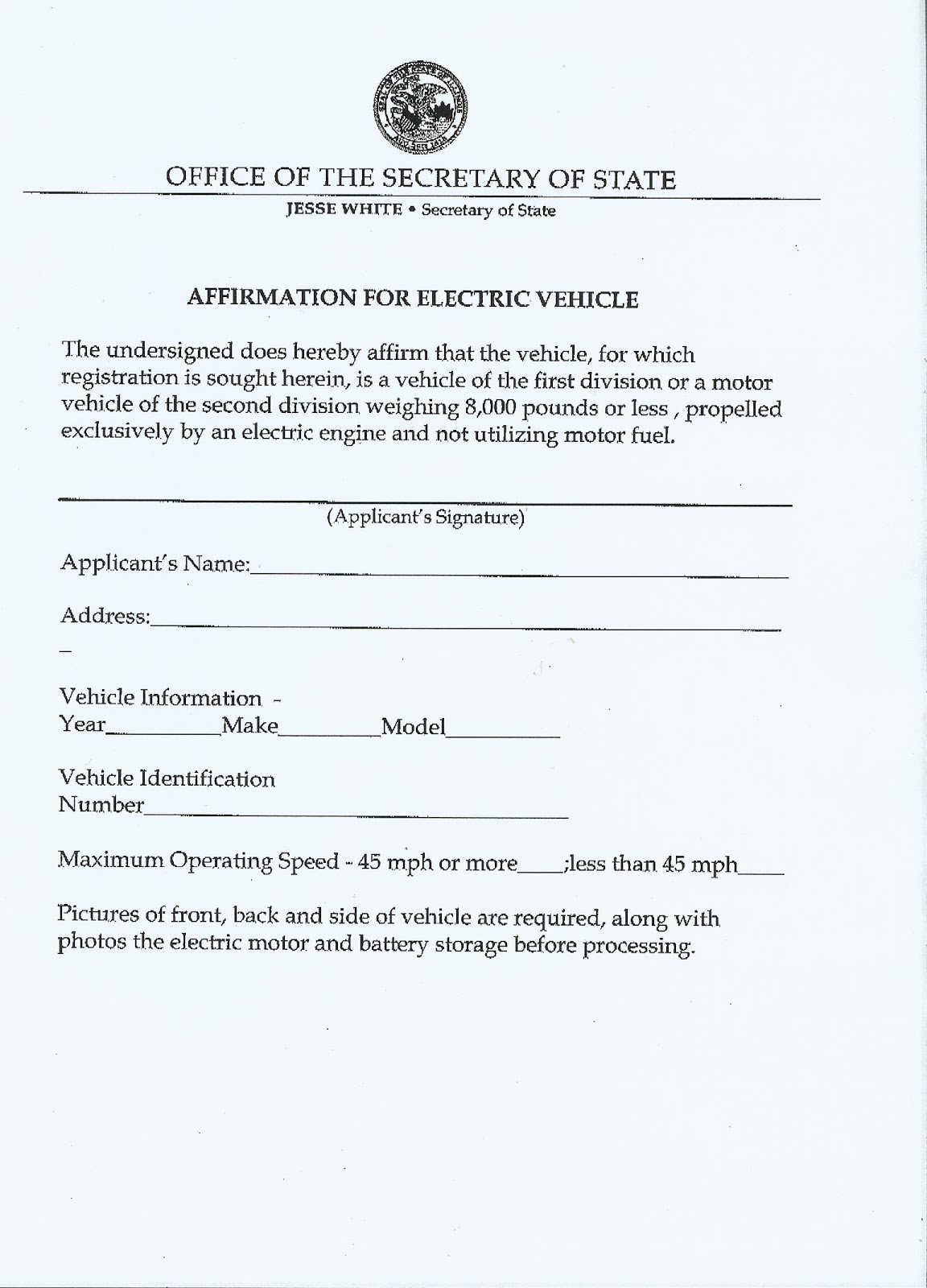
I originally applied by mail for my plates around October 20, 2012.  The first indication that was received that the application was being processed was discovering that the check cleared on November 1, 2012.  I figured that if something wasn't filled out properly, they would return the entire application and make me start over.  Fortunately that didn't just turn out to be a poor assumption on my part.  The strong feeling of cautious optimism was the result of the "modified" form I filed.  An AFFIRMATION FOR ELECTRIC VEHICLE is required to be filled out when submitting the application.  In an earlier post, I displayed  the official (but outdated) Illinois Secretary of State form.  As an advocate for Electric Vehicles, I really wanted to share the updated form that I created.  (I have updated this page to add an image of the form I used at the bottom of the page.)  My hesitation was in waiting to determine if that would be cause to reject my application.  So, on November 20, 2012 I returned home from work and checked the mail.  I had been checking the mail with eager anticipation for the last week.  My internal goal was to have the plates by Thanksgiving.   (For readers not familiar with Thanksgiving, it is a holiday in the United States of America on the fourth Thursday in November that is part remembrance of the European settlers arriving on the continent and a Autumn harvest festival.)  

DISPLAYING THE PLATE

The Mitsubishi dealership provided a plastic license plate frame with their dealership "advertising" on it at the time of purchase.  That was OK with the original passenger plates for the car.  But the Electric Vehicle plates deserve to be displayed more predominantly than the passenger plates.  The simple solution was to turn the plastic frame around and put it behind the plate.  The advantage of still using the plastic frame is that the metal license plate is not in direct contact with the plastic bumper which could lead to gouges in the bumper over time.  The front bumper does not have a factory license plate mount.  My solution was to use double-sided foam tape.

Front Plate mounted using double-sided foam tape.

These plates expire in December of 2013.  At that time, $38 will be charged to renew the plates for another two years.  The alternative, if I kept the passenger plates, would be to pay $99 per year.  The next step is to try to figure out how to get a refund for the plates I paid for when buying the car.  That will be another blog if I am successful.
AFFIRMATION FOR ELECTRIC VEHICLE

Below is the form that I submitted to the Secretary of State.  It was accepted for my application, it should work for anyone else also.

Sunday, October 28, 2012

Dispelling the Myths about Electric Vehicles

 There are a few criticisms that I see repeatedly.  Criticism is justified when it is true.  In addition to the criticisms are the false truths.  Some of these have originated from pre-production reviews and possibly after just reading media press kits.  Unfortunately too much of it appears to evolve around fear of the unknown or some type of perceived threat to life as people know it.  Let me list some of them and give a response.  Hopefully a response from someone with actual experience will have more weight than a critique from someone who has zero or limited actual experience.

1.    People won’t buy an EV unless they have charging stations nearby.  I have had my EV for two months.  In that time I have been able to perform 100% of my charging at home.  And from reading the i-MiEV forum (myimiev.com), there are plenty of others who have longer ownership time, and have done the same.  I even use just the factory supplied 120 Volt charger running on standard household current. 

2.    There aren’t enough charging stations around to support drivers.  This is similar to the criticism above, but I have seen it supported by stating the number of publicly available charging stations compared to the number of gas stations.  The huge omission that this leaves out is that charging can be done away from public stations.  If people were able to get gasoline from their house as easy as turning on a water faucet, there would be a lot less gas stations.  If charging could only be done away from the house, this statement might have some merit.

3.    You could run out of battery power somewhere inconvenient.  This criticism would be justified if it came from a person who routinely drives their car until it runs out of gas.  If a person has enough sense to realize how far their car can go before needing gas, they should be able to figure out how far their EV can go before needing a charge.  The difference is there is a larger safety net for fueled vehicles.  If a person lived in a small town where the only gas station closed at 8 PM every night and wasn’t open on Sundays, you would expect they would adjust their behavior to account for those limitations.

4.    Electric Vehicles are slow and can’t get out of their own way.  Have they heard of the Tesla Roadster?  But most of the time, the comment isn’t from someone who’s been in an electric car, it’s from someone who’s just looked at performance numbers.  How quickly does a person need to accelerate? Is every stop light treated like a drag race?  Actually, the Mitsubishi i-MiEV has the potential to accelerate quickly when driven.  But when I’m in my Zen-like state, I don’t feel the need to accelerate quickly (most of time, anyway).  If there is traffic behind me, I will accelerate in a responsible manner to avoid impeding the progress of those following.  After all, most EV owners are also advocates and promoters of EVs.  Therefore it is in our best interest to not offend those behind us and allow the “slow” stereotype to be advanced.

5.    The cost is too prohibitive.  As of yet there aren’t many people making that comment that have backed it up with a break-even analysis.  True, the initial purchase price is higher than another vehicle that may suit their transportation needs.  And the negative reviewers that warn against the price and the cost of charging tend to look at the extreme end of the spectrum when it comes to public utility rates for electricity.  There are a few ways to counter this.  One is logical.  The other is emotional. 
·         Logically, one compares costs for a new ICE (Internal combustion engine) car against an EV.  Costs include initial purchase price, rebates and incentives, operating costs and maintenance costs.  Residual value should be a component as well.  The quick comparison would be to calculate the difference in cost (after rebates, incentives, and financing costs for each) and decide the break-even point using the cost of gas and fuel economy against the cost of electricity and cost per mile to operate.  For my particular situation, the cost per mile to operate the i-MiEV is $0.015 per mile.  Let’s use the 2012 Ford Fiesta with a mid-range sticker price of $15,500 as a comparison.  It is an available sub-compact with 33 MPG fuel economy and let's use gas at $3.50 gallon.  That yields a cost of $0.11 per mile.  If the purchase cost difference is $14,500.00 then the break-even point is around 30,500 miles.  The calculation also takes into account the $7,500 federal tax credit and the Illinois state rebate of $3,000 for a $30,000 electric vehicle.  That’s not bad for most drivers.  For someone who drives 10,000 miles a year the break-even would be around 3 years.  (That would equate to around 200 miles a week.) 
·         On the emotional side let’s see how the decision to buy an EV stacks up against other major purchases.  Would you expect an accountant, who just bought two new wave runners with a trailer, to question the financial sense behind buying an EV?  When would buying a full dresser Harley Davidson make sense financially?  What about ski boats, fishing boats, sport bikes, and vacation homes?  Those are lifestyle purchases.  They are rarely tools that one needs to earn a living.  Yet why is it that an EV, which can be legitimately used on a daily basis to assist in earning an income, must be defended as a purchase?  We’ll congratulate the person who drives home in a new motorcycle or shows off pictures of some other new acquisition.  But EV owners are asked to justify their purchase.  It can be thought of as a lifestyle purchase that has the added benefit of serving a utilitarian purpose.  Or a utilitarian vehicle that trades range limitations for long-term operating cost savings while making a environmental statement.

6.    Owners are required to set up a 240V charger in their house.  This is just completely untrue.  Fortunately there has only been one occurrence of this statement that I have seen.  But the misinformation has a way of spreading and becoming a deterrent to those who may be "on-the-fence" and don't fact check.  The Geek Squad from Best Buy only comes out to determine if your current household wiring can handle the load for the 120V charger.

7.    There is only one cup holder! The truth is there are three.  One is immediately visible behind the hand brake lever between the front seats.  The other two flip out from just below the air ducts on the outside portion of the dash.  The shape of these cup holders is square and I’ve even seen references to people using these as smart phone holders.


8.    The charging of Electric Vehicles will place additional burden on an already strained electric grid.  A fairly large percentage of owners are charging their vehicles at night (after returning home from work) and some even time their charging for net metering to take advantage of lower utility rates.  So peak demand during the warmest part of Summer days isn't too much of an issue.  Here's something else to consider.  It takes electricity to make gasoline too.  It takes 6 kilowatt hours of electricity to refine a gallon of gasoline.  (http://gatewayev.org/how-much-electricity-is-used-refine-a-gallon-of-gasoline)  I can drive about 24 miles with that 6 kilowatts of electricity, and I haven't produced any tailpipe emissions in the process.

9.    The creation of electricity has an equal amount of negative environmental impact as the burning of fossil fuels.  This is the rebuttal from those trying to counter the “green” aspect of electric cars.  As mentioned above, electricity is used to create gasoline, then additional pollutants are released when the gas is used.


This may become an entry that gets updated as additional myths are found to dispel.

Saturday, October 27, 2012

Two Months Living with the Mitsubishi i-MiEV


So, what’s it like to have an electric car?


In a word, BRILLIANT! Every time I start driving I can’t help but think I’m on a Disney ride.  The quiet hum of the electric motor and the faint sound of road noise from the narrow tires makes me think I’m on an amusement park ride.  That’s not a bad thing.  I get child-like smirk across my face and feel like I jumped the track and exited the park.  Part of the feeling comes from the surreal and Zen-like quiet of the car while it is operating and part of the feeling comes from style of the car itself.  'Polarizing' comes to mind as to how people react to the shape.  You either admire it or you don’t.  It definitely departs from traditional styling without being too radical.  It is easy on the eyes and is welcoming rather than threatening.  If this car was in Mad Max it would be cast as a victim instead of as a villain.  For a person that is 6’3” (2m), the interior is accommodating.  I don’t feel cramped and have ample leg room and head room.  I doubt four occupants my size would want to travel for extended durations, but that wasn’t what the car was designed for anyway.  It would be the equivalent of reviewing a sport bike and complaining about the lack of storage space.

How is it used?


It’s only fair to give a real-world account of how I have used my i-MiEV over the last two months.  What good would it do to say it works for 95% of my driving without explaining what my driving requirements are?  A little background information is in order.  Between my wife and me, we own 5 vehicles and a motorcycle.  We have a two-car garage with enough extra space to keep the motorcycle inside, but 3 of the other 4 vehicles are in storage.  We are dual income with no kids and have a modest house which has been paid off for a few years.  We’re best described as middle-income with very few extravagances.  (If we were upper-income, I would have bought a Tesla instead.)  In two months time, over 650 miles have been put on the Mitsubishi.  45 of those miles were returning from the dealership with the car.  Therefore, the average is about 10 miles of driving per day.  My daily commute to work and back is 4 miles round-trip.  Other ways the mileage is accumulating is by trips to the grocery store, other shopping trips to department stores or malls, the occasional restaurant trip, and other miscellaneous driving around town.  The farthest from home the car has been since returning from the dealership is about 10 miles one-way to my brother’s house.  It’s not that I don’t have the confidence to take it farther, but I haven’t really had the need to go much farther.  We had contemplated what would have been a 35 mile round-trip excursion to an apple orchard, but the weather wasn’t cooperative the weekend we had planned on going.  Almost as important to mention are the trips I haven’t been able to use the EV. I built a fence a few weeks back.  The i-MiEV came in handy for trips back and forth to the hardware store for things like a new garden hose (for mixing concrete), gate latches, nails and screws.  What it didn’t get used for was picking up and returning the two-man auger used for drilling post holes, the two trips to pick up thirty 60-pound bags of cement mix, and the trip to get the 1.5 cubic yard cement mixer.  But those trips were not about range limitations.  If one of our other vehicles wasn’t a Dodge Nitro, the hauling of 3600 pounds of cement mix would have been a different logistical outcome than dividing it up into just two loads.  My wife uses the other vehicle as needed and if we need to head out-of-town it’s not a dilemma to choose a gas powered car with its “unlimited” range.  But I do face “pump anxiety”.  Pump Anxiety is a term I just created to describe the feeling one gets when filling a fuel tank and watching the cost accumulate as the gallons are added.  It can also be used to describe the anxiousness associated with evaluating the cost of fuel at different stations or on different days of the week depending on what world event has caused the price of oil to fluctuate.

Friday, October 19, 2012

ILLINOIS ELECTRIC VEHICLE PLATES (part 2)

How does one obtain Electric Vehicle Plates for the state of Illinois?

There are two forms that the Secretary of State provides which require completion in order to be issued plates for an EV.  (Note: I use EV as an abbreviation for Electric Vehicle, but the plates issued by IL will have a random number followed by EL.  The EL is for ELectric vehicle.  EV is already in use by the state for Exempt Vehicle.)  One form is the AFFIRMATION FOR ELECTRIC VEHICLE and the other is APPLICATION FOR VEHICLE TRANSACTION (VSD.190). 

The AFFIRMATION FOR ELECTRIC VEHICLE is not available online at the time of this writing.  I am also informed that the Affirmation should be updated in the near future.  Currently the form is intended for vehicles that have been converted to all electric.  As such, the form asks for pictures of the front, back and side of vehicle along with photos of the electric motor and battery storage.  The Vehicle Services Department should make the form clearer for originally manufactured electric power vehicles with the update.  And hopefully the form will be available online in much the same way that the AFFIRMATION FOR LOW-SPEED VEHICLE form (VSD.796) is on the SOS website.  Feel free to print a copy of the form below.  My local facility had to have this form faxed to them so the chances are you closest facility may have never seen this.  An important note: If you have an originally manufactured EV, the photos are not required.  If you are reading this before you buy, print a copy and take it to the dealership with you.


The second form required is an APPLICATION FOR VEHICLE TRANSACTION (VSD.190).  This is a form that a local facility should have.  A new car dealer should have these forms as well.  This is available online but not in a printable form, so avoid that route.  I wish I could provide complete instructions for filling out the form, but it will differ depending on if it is for new issue or reclassification because it was done wrong the first time.  A scan of the form for my Mitsubishi i-MiEV is attached.  Do not try to use a copy of this form since the bar code on the form has been erased and the form also has a section filled out in duplicate for when the plates are sent to the owner.  The one critical step is filling out ELECTRIC in box 3 for Plate Type Requested. 


Then there is the submission of the fee.  To reclassify the plates is $29 plus the fee for the plates themselves.  The plates are $35, $27, $18, or $9 depending on when during the two-year cycle they are bought.  Plates issued between Jan 1 and June 14 of even numbered years are $35.  Plates issued between June 15 and Dec 14 of even numbered years are $27.  Plates issued between Dec 15 of even numbered year and June 14 of odd numbered year are $18.  And finally plates issued between June 15 and Dec 31 of odd numbered years are $9.  After that the cost is $35 for a two-year renewal.  As an example, my plates will cost $56, the $29 fee plus the $27 "pro-rated" plate cost to have them issued in October of 2012.  If you are lucky enough to have an informed dealer and are getting plates issued at the time of purchase, the $9 thru $35 fee will apply instead of the $99 fee for PASSENGER plates.

So for now, both forms must be sent to Springfield for processing.  The local facilities cannot issue the plates.  You may be lucky enough to find one willing to send the paperwork to Springfied for you though. The address to send the two completed forms and payment is:

Secretary of State
Non-Standard Plates
501 S. 2nd St, Room 541
Springfield, IL 62756

I hope to be able to add information on how to obtain a refund for the $99 Passenger plate fee in the future.  That effort will more than likely take as much persistance as trying to find out how to get EV plates.

 Please feel free to Post a Comment if this information has helped you, if it is accurate, or if updates become available from the SOS.